Search This Blog

Showing posts with label Olives. Show all posts

Wednesday, 26 September 2018

Experiments with Gousto #9: Mediterranean Fish Stew & Sunny Aioli

Here we are with the final entry in the current run of Gousto recipes, and any others will be appearing on Instagram, while my more 'experimental' efforts, or anything particularly fun or interesting, will continue to appear - sporadically - on this blog. This recipe is the one where I ended up eating both portions because my girlfried was away - I had one portion on the Friday, when I did the actual cooking, and the second for lunch on the Saturday.

This turned out to be a Very Good Thing as it didn't all go according to plan on the Friday.

As before, I got the chopping out of the way ahead of time, attempting to be clever and using the mandoline for the onion, but mistaking the 'julienne' attachment for the 'fries' attachment and consequently setting the blade too low. This still gave me sliced onion, but with deep grooves cut into it rather than allowing it to separate into nice, small chunks. I did the carrots the old-fashioned way and chopped the garlic as finely as I could (news flash - still not that fine), where I'd grated it for a couple of the previous recipes and got uncomfortably close to grating my fingers. I should, perhaps, have used the garlic press for broadly similar results, but that didn't occur to me at the time.

The second step of this recipe confused me: heating a frying pan with "a drizzle" of olive oil and 15g of butter. Why so vague with one measure and so specific with the other? And using oil and butter? Surely one or the other would be more usual? Nevertheless, I followed the instructions as described. The stew part of the fish stew was easy enough, but puzzling on at least one other point: the inclusion of star anise. Now, clearly, I'm no expert in culinary matters, but star anise is described online as "one of the central spices in Chinese cooking", and supposedly has a strong anise flavour - whatever that may be - and a licorice-like aroma. I'm a big fan of licorice, and I have to say there was no licorice aroma. I couldn't say whether its presence in the making of the stew had any effect on the final flavour, but it had none that was discernible to my palate. I'd have to try cooking this again without star anise to be certain.

As with the previous recipe, I started preparing the stock ahead of time as well, though this one required the addition of turmeric to turn it into the required "yellow stock". Turmeric may well be the bane of my existance, but we'll get into that shortly... For now, let's focus on the stew. Any recipe which can be completed in one frying pan or saucepan is always going to be a winner, so I really liked that every stage of preparing the stew was simply a case of adding the next thing to the frying pan. With the onions, carrots and garlic cooked to the point where the onion was softening, the tomato paste went in, followed shortly by the stock and the olive, and the whole thing was left to reduce on a low heat while I switched over to preparing the sunny aioli and baking the rolls, which I'll go into separately. The fish caused an interesting complication, in that I was preparing the stew in a frying pan which has no lid, so I had to improvise - upending a wok and balancing it on the rim of the pan for the few minutes required to cook the fish. The final stage was simple enough - add in some of the fresh parsley, remove the star anise (which took longer than expected because it had managed to disguise itself very successfully), then serve with more of the parsley as a garnish, a ciabatta and the sunny aioli...

...Which is where it went awry for me. It's not often, even with an amateur like me working in the kitchen, that a recipe goes so wrong that something actually breaks. Sure, I've had cheap-and-cheerful bits of kitchen equipment break (most recently the Ikea can opener that was part of my kitchen starter kit, basically dissolved thanks to its cheap, plastic construction... it's almost 10 years old, but barely used). The sunny aioli seemed to be going swimmingly, too, until I lost my grip on the bowl I was using to mix it, allowing it to tumble to the floor - trailing sunny aioli - break unrecoverably and spill what little of the sauce wasn't already staining the white plastic/rubber of my fridge. Hence, the first photo features no sunny aioli.

It's probably a good thing my girlfriend wasn't around for this one, because I came very close to losing my temper over the breakage and spillage, and spent the evening grumbling to myself and cursing the bowl for its slipperiness. It had all been going really well up until that point, so falling at the last hurdle was a huge disappointment.

My second attempt, for lunch the following day, went far better, and the sunny aioli really added to the overall flavour. I may have to figure out other ways to use a similar sauce. This is a really lovely fish stew, and I'd definitely like to try making it again... though I'm not quite sure what the ciabatta adds to the meal, other than being something to soak up the last few drops of the stew.

In retrospect, I'm puzzled by the instruction to drizzle olive oil over the ciabatta rolls before sticking them in the oven. I ended up doing one with and one without the oil and, yes, there's a massive difference in the result... but the one with oil ended up extremely tough and crusty, while the other was more like what you might buy in a shop. I'm not massively keen on super-crusty bread, but each to their own...

Wednesday, 30 March 2016

Rouleaux Niçois/Cannelloni Niçoise-Style (à la Khoo)

Another of my little whims while on holiday around Easter was to leaf through Rachel Khoo's delightfully quirky recipe book, 'My Little French Kitchen' for something reasonably simple, but more complicated than the Croque Madame Muffins I tried last time (being almost four years ago now). I've actually tagged about a dozen things that I intend to try but, on this occasion, wanted something not too taxing, but still reasonably adventurous.

Since I quite like Italian food, but the closest I've ever come to actually cooking it from scratch is that staple of the single man's repertoire, Spag Bol (which isn't even really Italian), I thought I'd try this French take on an Italian dish. The recipe called for the purchase of fresh ingredients - even, for preference, fresh lasagne sheets - but, thankfully, didn't require an awful lot of chopping.

Back when I did those Croque Madame Muffins, I noted that the instructions in 'My Little French Kitchen' aren't always presented in the most logical - or strictly chronological - order and, yet again, I fell foul of this foible when working through this recipe. I did most of the prep work in advance, as I strive to do as often as possible, but there was a rather critical instruction regarding the lasagne that is placed as a footnote to the recipe, in smaller type, which I shall quote here:
Les petites astuces - tips if your lasagne sheets are a little dry, pop them in a bowl of boiling water for 30 seconds or so. When they are supple, drain them and pat dry with kitchen towel or a clean tea towel.
Now, considering that 'fresh lasagne' sheets, as bought from most supermarkets, are typically pretty dry, one would tend to think an instruction like that isn't merely one of 'the little tricks', but an integral part of the recipe, and should be inserted more prominently within the main text of the recipe... OK, sure, I remember being taught in High School that one should read through all instructions before commencing (and what a great laugh that lesson was)... but that exercise did not involve footnotes.

And I'm clearly less patient now than I was then.

Unbelievable, I know.

So, having peeled long ribbons of courgette and sliced the cooked peppers and artichoke (both from jars, and not as successfully drained as they could have been), it didn't occur to me to dunk the lasagne in hot water before staring to pile stuff onto them and, consequently, when I started to roll up my cannelloni, the lasagne sheets cracked quite spectacularly.

That wasn't the worst of my errors, though. When we went shopping, the punnet of cherry tomatoes we picked up was slightly short of the 500g specified on the recipe, the parsley we'd bought was soggy and browning slightly by the time I came to start cooking this, and I entirely forgot to spread the black olive tapenade onto the lasagne before adding the other stuff, so that ended up getting dumped into the tomato sauce.

While I wasn't far short of the 500g of cherry tomatoes, it seems I was sufficiently short to ensure there wasn't quite enough sauce to adequately douse the cannelloni so, once in the oven, the dish never reached the 'golden and bubbly' stage, because what little fluid there was seemed to boil off too quickly.

I also forgot to grate any lemon zest or add any lemon juice but, after all my many cock-ups, the end result was surprisingly edible. As learning experiences go, it wasn't half so annoying as my first attempt at that HelloFresh Peanut Satay thing, and I'm very keen to try thing again sometime soon with the right weight of cherry tomatoes (with perhaps a bit of added water, just in case), and remembering to spread the olive tapenade over some freshly-dunked fresh lasagne sheets. It was a remarkably simple and fun recipe, so it's a little frustrating to have ballsed it up so stupidly, but it proves I really need to get more practice in the kitchen...

...and read the bloody recipe more thoroughly.

This is the only dish of the three I cooked recently that I remembered to photograph, so enjoy...
"Green salad? We don't need no stinkin' green salad!"

Friday, 10 April 2015

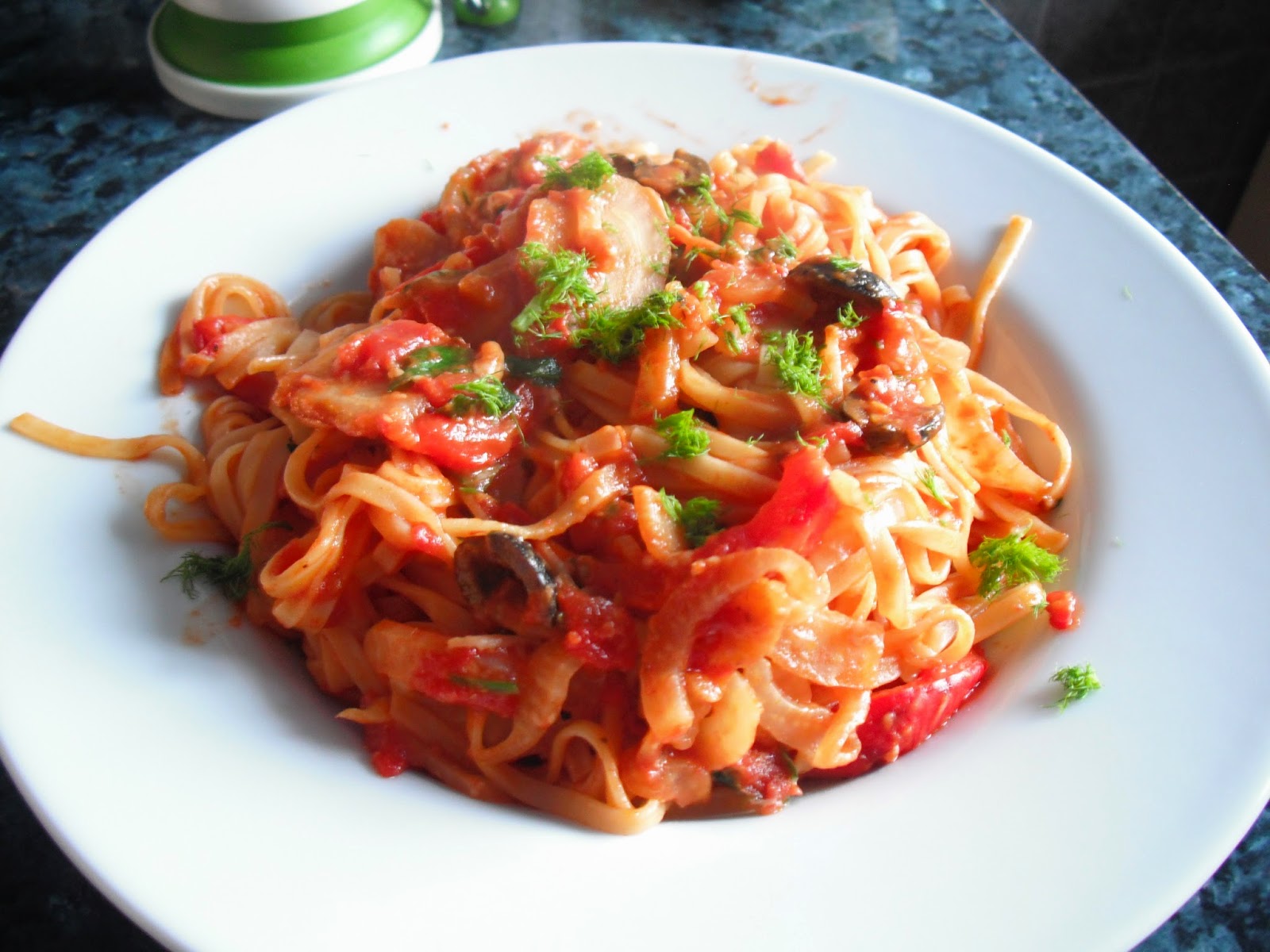
Experiments with HelloFresh #3: Fennel & Olive Fettuccine with Fresh Parsley

No, I haven't forgotten how to count, this should really have been the final post, but I'm temporarily skipping the second for reasons I'll get into when I finally post it. I'll also do the summing-up with that post rather than this one, as it'll make more sense that way.

As much as anything on this blog makes sense, that is.

After doing things in my usual haphazard fashion on the first recipe, my girlfriend mentioned that, when she's cooking, she'll often do snippets of preparatory chopping throughout the day, by way of a five minute break from her studies. While I wasn't quite that organised, I did make a start on this earlier in the evening than with any of my previous efforts, and did most of the chopping in advance of any of the actual cooking. I also followed another bit of her advice: she'd seen and heard my frustration with all the 'finely chop ingredient x' malarky in the first post and, when it came to the garlic, she suggested I simply use our garlic press. The end result is basically the same, if not better, and saves on an awful lot of effort. It was also nice to have a genuine reason to use my mortar and pestle for a change, grinding the fennel seeds - I knew I'd bought it for a reason...

I was particularly tickled, too, when the instructions helpfully suggested a mandolin for thinly slicing the fennel. My girlfriend picked one up a while back and, while it's not quite fine enough to generate the 'almost translucently thin' slices the instructions specified, it certainly made short work of slicing the awkwardly-shaped fennel bulb.

Once the chopping was out of the way, I read through the instructions several times over. Unlike the first two recipes, there weren't any massive glitches in the ingredient quantities (although specifying '2 cups' of sliced fennel bulb seemed redundant considering only one bulb was provided, and I kinda had to use the whole thing one way or another), so I really just wanted to be sure of what I needed to do next at every step, and to get a vague idea of the timings before starting things off. The second step in the recipe is cooking the red pepper strips, for which it recommends "15 mins or until lightly charred on the outside". The next step is cooking the rest of the veg in a pan, eventually turning it into a sauce for the pasta. The timings seemed to match up pretty well, so I started each process almost simultaneously, just to see if I could keep things on track.

The sauce comes together in several short stages that I found reasonably easy to follow since I had everything ready-prepared around me. The only hitch I'd had was that this recipe calls for black olives, and I definitely didn't get any black olives in the box. Thankfully, my girlfriend really likes olives, so we tend to have some in stock. The only real difficulty then was that, again, it specified the olive content as '2 tablespoons', which I still say is an utterly ridiculous measure for bisected fruit. Still, the definition gleaned from the first recipe helped me choose the appropriate number of olives for this dish. When the tinned tomatoes are added to the pan, the recipe suggests adding sugar but I've never found that necessary - tomatoes are sweet enough and, coupled with the rest of the veg, there's enough sugar in there naturally for my tastebuds. And that's saying something.

Once everything is in the pan, the recipe instructs that the heat should be turned down low so the sauce can boil down and thicken up, and it's at this point that the pasta needs to be cooked. Personally, I found it amusing that the card includes a definition of 'al dente' under the heading 'Tip', but your mileage may vary.

Just to prove that I'm not consistently terrible at cooking, the pasta was done only moments before the oven's alarm went off to tell me that the red pepper strips were ready, so both elements were added to the sauce in the pan in good time. The final stage was chucking in the parsley and the cheese (which strikes me as odd, and one of the Gousto recipes did the same, where my girlfriend and I would normally tend to add the cheese on top, once the meal had been served... not least because it means you don't end up having to scrape congealed cheese off your pan when you do the washing up). With a final garnish of - oh, for fuck's sake - 'finely chopped' fennel fronds, dinner was served...

Based on the two recipes I bothered photographing myself, I have to conclude that there's something wrong with HelloFresh's photography or their Photoshop work, as both this and the 'Easter' Ragu were depicted as rather brown in the stock photos, while they tended more toward red when I'd finished cooking... and I'm pretty sure I didn't get anything that significantly wrong on either of these.

As we were eating, my girlfriend commented that the fennel was identifiable in the sauce, but not overpowering, as fennel can sometimes be - being almost licorice in flavour. I certainly enjoyed the dish, but have to say I found it rather bland overall... it's possible I gave it too few "good grinds of black pepper", or that the chilli was just cooked for too long - it didn't have the spicy kick I was expecting, given that the first instruction says to "finely chop as much of the chilli as you dare". Perhaps I'll have to try this one again, and deliberately try to spice it up as much as possible...

This was definitely the easiest of the three HelloFresh recipes for me to follow, though how much of that was down to me doing more preparatory work in advance, and how much was because the recipe is actually easier, I cannot say. What I will say is that the card reckons this should be done in about 25 minutes, and I took the best part of an hour over it. Admittedly, most of that was due to taking my time over the preparatory work and my neurotic re-reading of the instructions, but that's a hell of a discrepancy. Not to say I particularly rate myself as any kind of kitchen ninja, but the folks at HelloFresh do seem to presume a level of competence far higher than mine.
Probably the neatest presentation I've ever managed when cooking
for myself and my girlfriend...

If you think you might fancy giving HelloFresh a try (and are within the UK mainland), please feel free to use my referral code MPMDQT for an introductory discount. Yes, that also gets me a discount on my next order, but further deliveries are currently on hold while I complete this first set of recipes and consider how this system fits in with my current... erm... 'lifestyle'.

Sunday, 19 May 2013

Red Onion, Feta and Olive Tart

Don't expect this to become a habit, but this is a home-made dish that I didn't even cook myself. Yep, I really can be that lazy sometimes!

Seriously, though, this was a fairly quick and light dinner for a warm spring day, which my girlfriend put together for me as a thank-you. The recipe originates in the BBC Good Food book 101 Veggie Dishes, but some minor changes were made to suit what was available in my fridge and at the local shops.

Ingredients (versus the original recipe):

  • 4 Small Onions (rather than 2 large)
  • Dark Muscovado Sugar (instead of the light kind)
  • 130g olives (rather than 175g (correction: 130g minus one - she just had to check they were alright before putting them on the tart...))
  • Approximately 150g Feta (compared to 100g)
  • The puff pastry was actually the ready-rolled, reduced fat kind

Preparation Time: The original recipe in the book states 45 minutes (or 30 on the website!) but, versus the breakdown, this was quicker to prepare at some stages and longer at others... so probably still about  30-45 minutes work, in total.

Tools Required:
  • Sharp Kitchen Knife, for to cut things
  • Chopping Board
  • Small Saucepan
  • Large Baking Tray (about 26cm x 38cm)
The Process:
Without duplicating the text of the BBC version, there's sadly very little to write about here. The onions were chopped, seasoned, fried, mixed with sugar and balsamic vinegar, then cooked till an appropriately syrupy consistency was achieved. This was done during the course of an afternoon, so the resulting caramelised topping for the tart had adequate time to cool before the next stage of preparation.

With the pastry being the ready-rolled variety, it was a case of fitting it to one of my baking trays, then assembling the toppings, doing the final baking stage (five minutes longer than the original recipe, since the pastry was not the kind it called for and thus reacted differently), and finally scattering on the shredded basil leaves prior to serving.

The Results:
One of the great miracles of home cooking, I find, is that traditionally savoury ingredients can often become very sweet when cooked in a particular way. Now, granted, caramelising the onions involves some sugar, and that's always going to affect the end result, making the onions artificially sweet. In this tart, we have the perfectly-pitched sweetness of caramelised red onions with counterpoints in both the bitterness of the olives and the saltiness of the Feta. Served warm, not long out of the oven, and accompanied by a light salad (most definitely not the sharp, bitter sort recommended by the recipe in the book! Why is rocket so popular?) it made for a pleasant, delicate meal for a warm spring evening (which gives you an idea of how long this post has been waiting!). The flavours complemented each other well, and the Feta's bite was nicely mellowed both by the baking and by being mixed in with the onion.

More than that, though, the remaining half became part of my lunch for the next two days, without any need for reheating. Some of the Feta's piquancy returned when eaten cool, but it never overpowered the caramelised onion, and the bitterness of the olives remained undiminished.

It has been suggested that, perhaps, a little more onion would have improved things. Comparing this tart to the photos in the book and on the BBC website, the depth of the main topping does appear to be a little lacking, but at least part of the reason is that my baking trays are far larger than those recommended by the recipe. I'd say the content was very well-balanced, especially since it tasted just as good cold as it had when warm.
Classy! (the 'wine' is actually Fentiman's Rose Lemonade (honest!))

Tuesday, 16 April 2013

Adventures in Omelette #6 & 7: Spinach & Feta / Mozarella & Olive Frittatas

A dual post, possibly to make up for another very long break - I honestly didn't think it had been two and a half months since my last post, but at least I've been otherwise occupied rather than just being completely lazy.

I mean, I've been completely lazy as well, but managing to get a few things done - including some cooking - along the way.

These two were quick Frittata experiments with my girlfriend, who's vegetarian and so not very interested in the meaty/fishy kind of thing I normally throw together. Naturally, the process is the same, so I won't go into details... you may simply revel in the photographs and read the brief comments which accompany them.

This one in particular is essentially one of my normal frittata concoctions without the meat. Spinach and feta can go along with salmon or tuna, certainly, so it was nothing unusual, really.

If I remember correctly, this one ended up being either five or six eggs, simply because I was using the larger frying pan to ensure two decent portions. Many ready-made things one tends to find in shops consider a 20cm pan adequate for serving two... I do not. I prefer a proper portion, thank you very much.
Of course, many of those ready-made things assume you're going to be serving the frittata with something additional - a salad, perhaps... I do not. I prefer omelettes and frittatas to be the whole meal, in and of themselves, perhaps accounting for my preference for larger portions.

The end result was just as tasty as it would have been with the addition of meat or fish, just that little bit lighter, and without all the fuss of scooping out the suspicious-looking meaty/fishy bits. An excellent, quick, light lunch.


Mozarella and Olive, meanwhile, was a semi-deliberate attempt at something even lighter. Mozarella is a very soft, creamy cheese, so it seems as ideal for omelettes and fritattas as it does for pizza topping. Olives provide a little bite.

This frittata seemed to rise a little more (and a little more evenly), possibly because I turned it under the grill a few times - looking at the way my grilled food comes out, it sometimes appears that one side is more effective than the other.
There were two downsides to using mozarella as the cheese component in this particular fritatta. First, its tendency to form long strings when pieces are cut off and separated. Second, it's an incredibly light, mild, creamy cheese... so it didn't add much by way of flavour to the end result. Not to say this wasn't tasty... just that the olives and the eggs were really the only things providing any actual flavour. I suspect that a mixture of black and green olives, or some other additional component, would have been worth considering for this version.
Both of these turned out well, and certainly filled a lunchtime hole but, in purely flavour terms, the former is the clear winner. Both the spinach and the feta offered the most bite, not to mention a little more variation in texture. The latter recipe certainly needed a little something extra, whether it be something as simple as seasoning, an additional cheese, or more chunky ingredients to supplement the olives in the otherwise creamy mass.

This calls for some experimentation!