Of all the Gousto recipes I've tried so far (cooking myself, that is), this is probably my favourite so far. It turned out to be pretty much as quick and easy as the recipe suggests, but there were still a couple of things I didn't get quite right...
For starters, I've got into the habit of doing as much chopping as possible in advance, since I can never be sure I'll be able to keep to the timings if I have to chop on the fly. For this one, I also put the sweet tomato stock together in advance. This almost came a-cropper before I'd started, as my usual jug is far smaller than the 700ml required, so I had to resort to a crappy (but larger) plastic jug from my Ikea kitchenware set. I don't particularly like using it - especially for hot things - but there's really no rational reason for that... I just prefer working with glass/Pyrex jugs where available.
I got my girlfriend to explain how she would go about dicing onion, because my 'method' invaribly ends up making a lot of mess and leaving me with streaming eyes. In fact, in a previous recipe (not one I've documented, as far as I can remember) I diced an onion using our mandoline with the additional blades intended for slicing potatoes into French Fries. This time, I just used a standard kitchen knife, though I did have to sharpen it beforehand.
I was a little concerned by step 4 of this recipe, where smoked paprika, ground turmeric and chopped garlic are added in along with the dry arborio rice, as I don't feel especially confident about adding dry rice to anything where there's not much liquid available. One of these days, I'm sure I'll just end up with Rice Krispies... Not this day, though... thankfully...
Also, to be honest, it's only in the pan for about a minute before the stock is gradually added in, and this stage takes about 15-20 minutes for it to be absorbed by the rice, while the sliced peppers are being roasted in the oven. I think I started this stage a little too late - with only about 17 minutes remaining on the peppers' cooking time - so I ended up switching the oven off for the last few minutes of the risotto's cooking time.
The fact that almost everything for this recipe comes together in a single frying pan is a huge bonus. It means less to keep an eye on, and less to wash up at the end. I do have a few objections to the act of adding cheese to something that's already a hot, sticky mess in a frying pan, because I know from previous experience how troublesome that sort of combination will be to clean afterward. I also found the cheese supplied to be extremely crumbly, which made grating it an absolute chore, and I came dangerously close to grating my fingertips whenever a chunk broke off.
To be perfectly honest, I'm not certain whether or not any pepper was added for seasoning, along with the cheese and chives, but I'm pretty confident - having tasted the end results - that it would work well enough without. The final stage was a bit of a rush, as I had to dish out the risotto, add the remaining peppers, cheese and chives, drizzle on a bit of olive oil (also, I strongly suspect, surplus to requirement), and take some photos before announcing that dinner was ready... and I hadn't even brought the camera into the kitchen in advance this time...
This is the first of the new batch of Gousto recipes that arrived yesterday, so the rest have a hard act to follow now. The next few will be interesting as, after tonight's, I'll actually be cooking for myself for a couple of nights, as Courtney's out for the evenings, then away for the weekend... and I'm not sure keeping some of the ingredients till she's back - even keeping them in the fridge - will be viable. Chances are, I'll be cooking up the whole recipe as usual, but keeping a portion in the fridge (or the freezer) till she's back.
Showing posts with label Peppers. Show all posts
Wednesday, 16 May 2018
Thursday, 27 October 2016
Smoked Haddock Paella (sort-of à la Slimming World)
I'd like to call it a tradition that I cook dinner while I'm off work but, over the last couple of years, Courtney and I have usually been doing something - like taking a holiday - which means there's actually not much of an opportunity to cook, and when I'm off work due to illness, cooking couldn't be further from my mind. This week - coming at a bad time for going away - has presented the first good opportunity (other than, y'know, every frickin' weekend) for me to get back into the kitchen and prepare some meals from scratch... But it didn't happen without a struggle. We'd talked about it a while back but, in the run-up to the week, Courtney became reluctant to pick meals for me to cook. I had previously become a little stressed during other stints in the kitchen and she felt that she wanted to spare me the upset.
Nevertheless, a handful of recipe suggestions were eventually teased out of her and, on the Wednesday, I tried my hand at an adaptation of a 'Syn-Free' Slimming World recipe for a vegetarian/vegan paella, with a bit of fish added because we happened to have it in the freezer, otherwise unused. There were a couple of other changes to the recipe, so I'll give this the full write-up...
Ingredients:
Tools Required:
This is one of those recipes where it pays to prepare in advance. Before even firing up the hob, I cooked the two haddock fillets (thawed overnight in the fridge, then approximately 5 minutes in the microwave, breaking halfway to drain the excess water, and then removing the skin and flaking the fish at the end), mixed up the spices in a small bowl (since it's easier to mix in the paprika, cumin, turmeric and saffron evenly if they're already mixed up and ready to be dumped into the wok) and chopped up all the veg. While I would never say that I've got chopping things down to a fine art, I do find it easy enough to deseed and slice up things like peppers. Slicing things like onions has become far easier for me since we acquired a mandoline (the Chef'n Pull'n'Slice mandoline from Lakeland, specifically) but, even so, I had to cover over the onion slices once finished to avoid getting all weepy. The tomatoes were slightly more complicated to slice up because they also needed to be deseeded, and that's the gooiest portion of the tomato. On the upside, none of the slicing needs to be especially fine, and all I did with the artichoke hearts was drain them and halve them. I made a lot of extra washing up by using bowls and plates to store things once prepared, so I could simply line them up and add them into the wok as I progressed. The frozen peas were measured out, then stored in the fridge till needed. One of the lemons was juiced, while the other, which only needed cutting into wedges, was set aside.
I also dealt with the stock before the main part of the cooking, putting just over a litre of water into a saucepan, dropping in the three vegetable stock cubes and bringing it to the boil. Stirring occasionally to help the stock cubes break up, I then made a start on the main event.
The wok received a spraying of cooking oil before turning on the hob to a medium heat. As a side note, I'm slowly learning how to set temperature levels on the hob - high and low being obvious, but 'medium' sitting somewhere below the median - so just about every stage of this recipe proceeded as intended. First into the wok were the sliced onion and the crushed garlic, these being cooked gently - and kept on the move to prevent them sticking to the wok - till the onions started turning golden (a little over five minutes). I did splash a spoonful or two of the stock in early as I suspect I didn't spray in quite enough cooking oil.
Next up came the peppers, with the whole lot continuing to stir-fry for about another five minutes. The next stage starts out with a flurry of activity before settling down for a long simmer: the tomatoes, rice (added dry) and the spice mix go in next, along with a small amount - about a tablespoon or so - of the lemon juice and then stirred up. The final part of this stage is adding the stock and, since I wasn't quite sure of myself on this point, I ended up adding it gradually rather than all at once. I ended up not using all of it, as the extra was just a precaution, but very little was left over. This then needs to simmer down for around a quarter of an hour or so, to allow the rice to absorb water and cook. It's worth giving it all a stir once in a while, as I did find that my rice sank to - and then stuck to - the bottom of the wok.
The final stage starts by adding the frozen peas and chopped artichoke, then simmering for another ten minutes or so, leaving you with something resembling paella, rather than a chunky vegetable soup - you want it moist, but not waterlogged. The last thing to be added to the wok, preferably in the last couple of minutes before serving, is the flaked haddock. After that, it's simply a case of serving up, seasoning to taste, then chopping the remaining lemon into wedges to squeeze over the top.
The Results:
Given the time I'd put in to preparation before I started, I was pleased to find this all progressed very smoothly. Because my worktop space is fairly limited, I'd dotted bowls and plates around the available space, piling them up as I emptied them into the wok. My biggest concern was getting the hob temperature right for boiling off the excess water to ensure the correct texture/viscosity in the end result, but the only problem with the simmering stage was that I didn't keep the rice moving, so quite a bit ended up as a congealed, crispy mass at the bottom of the wok... but even that wasn't a complete disaster, as Courtney likes crispy congealed rice.
The original Slimming World version of this recipe suggests garnishing with shredded parsley, but that's not something we tend to have in stock as it's not something we use a great deal of - it seems like a huge waste to buy some only to tear up a small amount to sprinkle over something like this. I seasoned mine only very slightly - a little salt and a touch of pepper - as I wanted to try it with as little extra flavouring as possible. I was a little concerned, for example, that smoked haddock might have too strong a taste in its own right, but that turned out OK - blending in without losing its own flavour. While the tomato pretty much fell apart, becoming part of the sauce and leaving only the strips of skin, the other veg held together well, maintained some of their bite and kept their individual flavours to a degree. Adding a squeeze of lemon juice didn't do much, and I suspect a sprinkle of fresh parsley may have been a worthwhile addition after all. I'm not entirely sure what the difference is between 'paella rice' and the arborio rice I used, but I can't imagine the results would have been massively improved by using the 'correct' rice.
Aside from all the preparation work and small amount of waste due to the rice getting stuck to the bottom of the wok, this was a simple recipe that turned out very well and restored some of my kitchen confidence. The recipe in the book isn't exactly comprehensive, assuming a certain amount of experience, but I was able to read between the lines and keep things progressing, without getting stressed out by re-reading the same lines over and over, trying to discern what I might be missing.
This is, at heart, a vegetarian dish, so it would be perfectly acceptable in its unadulterated form, yet it could easily support other white fish, or perhaps a full-on meaty component... as long as it's not something too strongly flavoured in its own right.
The quantities specified are meant to serve four, but we both had fairly generous servings, and Courtney took the leftovers for today's lunch. She had it cold, and reported that it was still quite flavourful, though she felt a bit of extra salt and pepper would have improved it, and hadn't taken any with her. She also reckoned it had reached the consistency where it could be turned into rice balls or patties, so that's perhaps something to investigate further in future.
Nevertheless, a handful of recipe suggestions were eventually teased out of her and, on the Wednesday, I tried my hand at an adaptation of a 'Syn-Free' Slimming World recipe for a vegetarian/vegan paella, with a bit of fish added because we happened to have it in the freezer, otherwise unused. There were a couple of other changes to the recipe, so I'll give this the full write-up...
Ingredients:
- Smoked Haddock (a couple of small fillets should be enough)
- Onion (one of a decent size is sufficient, to be sliced)
- Garlic (a couple of cloves, to be crushed)
- Peppers (one red, one yellow, to be sliced)
- Tomatoes (four, to be sliced - the original recipe specifies plum tomatoes, but I used the normal kind)
- Lemons (one to be juiced, one to be cut into wedges)
- Peas (200g, frozen)
- Artichoke Hearts (one 400g tin - equating to about 240g of artichoke when drained)
- Arborio Rice (largely because we couldn't find anything called 'Paella Rice', 350g)
- Paprika (2 teaspoons)
- Cumin (1 teaspoon)
- Turmeric (half teaspoon)
- Saffron (just a pinch, however one measures that...)
- Vegetable Stock Cubes (3 should be sufficient, to be dissolved in about a litre of water)
- Salt & Pepper (to taste)
- Cooking Oil (to lubricate the wok in the initial stages)
Tools Required:
- 1 Large Wok or Frying Pan
- 1 Saucepan (large enough to comfortably accommodate 1 litre of boiling water)
- 1 Kitchen Knife
- 1 Mandoline (because it makes slicing the onion far easier on the eyes)
- 1 Garlic Press
- Miscellaneous receptacles to contain the ingredients prior to adding to the wok
- 2 Stirring Implements (one for the wok, one for the stock)
This is one of those recipes where it pays to prepare in advance. Before even firing up the hob, I cooked the two haddock fillets (thawed overnight in the fridge, then approximately 5 minutes in the microwave, breaking halfway to drain the excess water, and then removing the skin and flaking the fish at the end), mixed up the spices in a small bowl (since it's easier to mix in the paprika, cumin, turmeric and saffron evenly if they're already mixed up and ready to be dumped into the wok) and chopped up all the veg. While I would never say that I've got chopping things down to a fine art, I do find it easy enough to deseed and slice up things like peppers. Slicing things like onions has become far easier for me since we acquired a mandoline (the Chef'n Pull'n'Slice mandoline from Lakeland, specifically) but, even so, I had to cover over the onion slices once finished to avoid getting all weepy. The tomatoes were slightly more complicated to slice up because they also needed to be deseeded, and that's the gooiest portion of the tomato. On the upside, none of the slicing needs to be especially fine, and all I did with the artichoke hearts was drain them and halve them. I made a lot of extra washing up by using bowls and plates to store things once prepared, so I could simply line them up and add them into the wok as I progressed. The frozen peas were measured out, then stored in the fridge till needed. One of the lemons was juiced, while the other, which only needed cutting into wedges, was set aside.
I also dealt with the stock before the main part of the cooking, putting just over a litre of water into a saucepan, dropping in the three vegetable stock cubes and bringing it to the boil. Stirring occasionally to help the stock cubes break up, I then made a start on the main event.
The wok received a spraying of cooking oil before turning on the hob to a medium heat. As a side note, I'm slowly learning how to set temperature levels on the hob - high and low being obvious, but 'medium' sitting somewhere below the median - so just about every stage of this recipe proceeded as intended. First into the wok were the sliced onion and the crushed garlic, these being cooked gently - and kept on the move to prevent them sticking to the wok - till the onions started turning golden (a little over five minutes). I did splash a spoonful or two of the stock in early as I suspect I didn't spray in quite enough cooking oil.
Next up came the peppers, with the whole lot continuing to stir-fry for about another five minutes. The next stage starts out with a flurry of activity before settling down for a long simmer: the tomatoes, rice (added dry) and the spice mix go in next, along with a small amount - about a tablespoon or so - of the lemon juice and then stirred up. The final part of this stage is adding the stock and, since I wasn't quite sure of myself on this point, I ended up adding it gradually rather than all at once. I ended up not using all of it, as the extra was just a precaution, but very little was left over. This then needs to simmer down for around a quarter of an hour or so, to allow the rice to absorb water and cook. It's worth giving it all a stir once in a while, as I did find that my rice sank to - and then stuck to - the bottom of the wok.
The final stage starts by adding the frozen peas and chopped artichoke, then simmering for another ten minutes or so, leaving you with something resembling paella, rather than a chunky vegetable soup - you want it moist, but not waterlogged. The last thing to be added to the wok, preferably in the last couple of minutes before serving, is the flaked haddock. After that, it's simply a case of serving up, seasoning to taste, then chopping the remaining lemon into wedges to squeeze over the top.
The Results:
Given the time I'd put in to preparation before I started, I was pleased to find this all progressed very smoothly. Because my worktop space is fairly limited, I'd dotted bowls and plates around the available space, piling them up as I emptied them into the wok. My biggest concern was getting the hob temperature right for boiling off the excess water to ensure the correct texture/viscosity in the end result, but the only problem with the simmering stage was that I didn't keep the rice moving, so quite a bit ended up as a congealed, crispy mass at the bottom of the wok... but even that wasn't a complete disaster, as Courtney likes crispy congealed rice.
The original Slimming World version of this recipe suggests garnishing with shredded parsley, but that's not something we tend to have in stock as it's not something we use a great deal of - it seems like a huge waste to buy some only to tear up a small amount to sprinkle over something like this. I seasoned mine only very slightly - a little salt and a touch of pepper - as I wanted to try it with as little extra flavouring as possible. I was a little concerned, for example, that smoked haddock might have too strong a taste in its own right, but that turned out OK - blending in without losing its own flavour. While the tomato pretty much fell apart, becoming part of the sauce and leaving only the strips of skin, the other veg held together well, maintained some of their bite and kept their individual flavours to a degree. Adding a squeeze of lemon juice didn't do much, and I suspect a sprinkle of fresh parsley may have been a worthwhile addition after all. I'm not entirely sure what the difference is between 'paella rice' and the arborio rice I used, but I can't imagine the results would have been massively improved by using the 'correct' rice.
Aside from all the preparation work and small amount of waste due to the rice getting stuck to the bottom of the wok, this was a simple recipe that turned out very well and restored some of my kitchen confidence. The recipe in the book isn't exactly comprehensive, assuming a certain amount of experience, but I was able to read between the lines and keep things progressing, without getting stressed out by re-reading the same lines over and over, trying to discern what I might be missing.
This is, at heart, a vegetarian dish, so it would be perfectly acceptable in its unadulterated form, yet it could easily support other white fish, or perhaps a full-on meaty component... as long as it's not something too strongly flavoured in its own right.
The quantities specified are meant to serve four, but we both had fairly generous servings, and Courtney took the leftovers for today's lunch. She had it cold, and reported that it was still quite flavourful, though she felt a bit of extra salt and pepper would have improved it, and hadn't taken any with her. She also reckoned it had reached the consistency where it could be turned into rice balls or patties, so that's perhaps something to investigate further in future.
| Snapped prior to the addition of a little salt and pepper... |

Wednesday, 30 March 2016
Rouleaux Niçois/Cannelloni Niçoise-Style (à la Khoo)
Another of my little whims while on holiday around Easter was to leaf through Rachel Khoo's delightfully quirky recipe book, 'My Little French Kitchen' for something reasonably simple, but more complicated than the Croque Madame Muffins I tried last time (being almost four years ago now). I've actually tagged about a dozen things that I intend to try but, on this occasion, wanted something not too taxing, but still reasonably adventurous.
Since I quite like Italian food, but the closest I've ever come to actually cooking it from scratch is that staple of the single man's repertoire, Spag Bol (which isn't even really Italian), I thought I'd try this French take on an Italian dish. The recipe called for the purchase of fresh ingredients - even, for preference, fresh lasagne sheets - but, thankfully, didn't require an awful lot of chopping.
Back when I did those Croque Madame Muffins, I noted that the instructions in 'My Little French Kitchen' aren't always presented in the most logical - or strictly chronological - order and, yet again, I fell foul of this foible when working through this recipe. I did most of the prep work in advance, as I strive to do as often as possible, but there was a rather critical instruction regarding the lasagne that is placed as a footnote to the recipe, in smaller type, which I shall quote here:
And I'm clearly less patient now than I was then.
Unbelievable, I know.
So, having peeled long ribbons of courgette and sliced the cooked peppers and artichoke (both from jars, and not as successfully drained as they could have been), it didn't occur to me to dunk the lasagne in hot water before staring to pile stuff onto them and, consequently, when I started to roll up my cannelloni, the lasagne sheets cracked quite spectacularly.
That wasn't the worst of my errors, though. When we went shopping, the punnet of cherry tomatoes we picked up was slightly short of the 500g specified on the recipe, the parsley we'd bought was soggy and browning slightly by the time I came to start cooking this, and I entirely forgot to spread the black olive tapenade onto the lasagne before adding the other stuff, so that ended up getting dumped into the tomato sauce.
While I wasn't far short of the 500g of cherry tomatoes, it seems I was sufficiently short to ensure there wasn't quite enough sauce to adequately douse the cannelloni so, once in the oven, the dish never reached the 'golden and bubbly' stage, because what little fluid there was seemed to boil off too quickly.
I also forgot to grate any lemon zest or add any lemon juice but, after all my many cock-ups, the end result was surprisingly edible. As learning experiences go, it wasn't half so annoying as my first attempt at that HelloFresh Peanut Satay thing, and I'm very keen to try thing again sometime soon with the right weight of cherry tomatoes (with perhaps a bit of added water, just in case), and remembering to spread the olive tapenade over some freshly-dunked fresh lasagne sheets. It was a remarkably simple and fun recipe, so it's a little frustrating to have ballsed it up so stupidly, but it proves I really need to get more practice in the kitchen...
...and read the bloody recipe more thoroughly.
This is the only dish of the three I cooked recently that I remembered to photograph, so enjoy...
Since I quite like Italian food, but the closest I've ever come to actually cooking it from scratch is that staple of the single man's repertoire, Spag Bol (which isn't even really Italian), I thought I'd try this French take on an Italian dish. The recipe called for the purchase of fresh ingredients - even, for preference, fresh lasagne sheets - but, thankfully, didn't require an awful lot of chopping.
Back when I did those Croque Madame Muffins, I noted that the instructions in 'My Little French Kitchen' aren't always presented in the most logical - or strictly chronological - order and, yet again, I fell foul of this foible when working through this recipe. I did most of the prep work in advance, as I strive to do as often as possible, but there was a rather critical instruction regarding the lasagne that is placed as a footnote to the recipe, in smaller type, which I shall quote here:
Les petites astuces - tips if your lasagne sheets are a little dry, pop them in a bowl of boiling water for 30 seconds or so. When they are supple, drain them and pat dry with kitchen towel or a clean tea towel.Now, considering that 'fresh lasagne' sheets, as bought from most supermarkets, are typically pretty dry, one would tend to think an instruction like that isn't merely one of 'the little tricks', but an integral part of the recipe, and should be inserted more prominently within the main text of the recipe... OK, sure, I remember being taught in High School that one should read through all instructions before commencing (and what a great laugh that lesson was)... but that exercise did not involve footnotes.
And I'm clearly less patient now than I was then.
Unbelievable, I know.
So, having peeled long ribbons of courgette and sliced the cooked peppers and artichoke (both from jars, and not as successfully drained as they could have been), it didn't occur to me to dunk the lasagne in hot water before staring to pile stuff onto them and, consequently, when I started to roll up my cannelloni, the lasagne sheets cracked quite spectacularly.
That wasn't the worst of my errors, though. When we went shopping, the punnet of cherry tomatoes we picked up was slightly short of the 500g specified on the recipe, the parsley we'd bought was soggy and browning slightly by the time I came to start cooking this, and I entirely forgot to spread the black olive tapenade onto the lasagne before adding the other stuff, so that ended up getting dumped into the tomato sauce.
While I wasn't far short of the 500g of cherry tomatoes, it seems I was sufficiently short to ensure there wasn't quite enough sauce to adequately douse the cannelloni so, once in the oven, the dish never reached the 'golden and bubbly' stage, because what little fluid there was seemed to boil off too quickly.
I also forgot to grate any lemon zest or add any lemon juice but, after all my many cock-ups, the end result was surprisingly edible. As learning experiences go, it wasn't half so annoying as my first attempt at that HelloFresh Peanut Satay thing, and I'm very keen to try thing again sometime soon with the right weight of cherry tomatoes (with perhaps a bit of added water, just in case), and remembering to spread the olive tapenade over some freshly-dunked fresh lasagne sheets. It was a remarkably simple and fun recipe, so it's a little frustrating to have ballsed it up so stupidly, but it proves I really need to get more practice in the kitchen...
...and read the bloody recipe more thoroughly.
This is the only dish of the three I cooked recently that I remembered to photograph, so enjoy...
| "Green salad? We don't need no stinkin' green salad!" |
Friday, 25 March 2016
HelloFresh Revisited: Double Peanut Satay Stir Fry with Thai Holy Basil & Bok Choy
Clearly I haven't been doing a great deal of cooking recently, but I've been off work for most of this week - by choice, this time, rather than through illness - and my girlfriend and I had been discussing for quite some time that this would provide the ideal opportunity for her to take a break from slaving over the hot stove, and for me to get in some more practice over that same hot stove.
Since my last couple of stints of cooking dinner were both sets of three dishes (one from Gousto, the other from HelloFresh), I figured I'd start by looking over their recipe cards, and my eyes naturally fell on my biggest failure from that batch of experiments. I always say that one learns more from a single failure than from any number of successes, but I've yet to put that properly into practice in the kitchen. The first change I made was obvious - using products I already had in stock, or were bought at the supermarket - basically things that didn't have to be wrestled out of weird 'portion-sized' packets and things that I'd gone and got for myself based on the ingredients list.
My biggest gripes about HelloFresh generally were the imprecise and illogical measures they used for some items, and the wonky order of events presented by the instructions. Having cocked it up once, I had a better idea of how and where to start, so I began by mixing the Satay sauce - 2 large tablespoons of peanut butter straight out of my kitchen cupboards, 1 tablespoon of the sweet chilli sauce lurking in my fridge, and a tablespoon of soy sauce (light or dark is not actually specified in the recipe, but the first bottle I picked up was light, so I used that) all stirred together in a small bowl. This was an interesting step, because the peanut butter in my cupboard had separated when I last used it, and stirring it thoroughly still left it roughly "the consistency of runny honey", which description was the source of just one of the issues I had the first time round. Adding the two sauces thinned it out further, but then I left the sauce aside... and while I worked on the other steps, it thickened up considerably. By the time I was doing the noodles, I really did need to add some of the boiling noodle water, but the recipe's estimate of "a couple of tbsp" wasn't entirely sufficient to correct the consistency - I ended up using four or five, and could probably have used a couple more without overly diluting the resultant sauce.
Next up came the chopping of the veg - which, as usual, took far longer than it should have done because I'm still terrible at chopping veg. I did save some time and effort by grating the ginger rather than chopping it finely, because attempting to chop things finely still really pisses me off. I put the grated ginger and the discs of the white parts of the spring onions into one small bowl since they're added together, then the red peppers (sliced not quite to half centimetre matchsticks, but close enough) and the sugar snap peas into a second bowl since they're also added together. Next up, I sliced the bok choy (or 'pak choi', as Morrisons call it) and set that aside in another bowl, then chopped up the green parts of the spring onions and put them an a small bowl of their own.
Finally, in this pageant of proper preparedness, primed to prevent a plural of poor performances, I poured a handful of dry roasted peanuts into the mortar I barely use and lightly crushed them with the pestle I rarely touch. Hey, they look nice in my kitchen, OK?
Then and only then did I start on the noodles. My girlfriend has shown me a neat trick where you boil your water in a kettle before putting it in the saucepan, and that does seem to cut down the cooking time simply because a kettle boils water far quicker than a gas hob, so the noodles could be added sooner, so their four minutes were up sooner. Again, I followed the advice of HelloFresh and put the cooked noodles into a pan of cold water to keep them ready (and loose) till they were needed.
The actual cooking part is very quick - part of the problem I had the first time round was that the fourth step of the recipe, the stir-fry, takes only a little over five minutes, but everything has to be ready and to hand so that things actually happen in the necessary quick succession.
When it came time to add the Satay sauce, I still managed to fluff things up a little: it looked at first as if there still wasn't enough (hence the impression that I could have added more of the noodle water) and by the time it was bubbling, some of it had already stuck to the bottom of my wok. Still, it mixed in nicely enough and everything seemed to get a decent coating of the sauce, so things were looking positive. I had, of course, singularly failed to tear up some basil (the normal kind, as the Thai variety was nowhere to be found in the supermarket or my local grocers), but that was soon enough accomplished. The final steps were sprinkling over the crushed nuts and the green bits of the spring onion. Still no prayers to the gods of Thai cooking, but equally no colourful oaths muttered under my breath... and my girlfriend was pleased to find I wasn't utterly losing my rag over dinner this time.
Oh, and it tasted fantastic... Much, I suspect, as it is intended...
I was especially pleased with the sauce, as I really could taste the note of ginger and the sweetness of the chilli sauce in the Satay - even the shredded basil wasn't utterly overwhelmed by the large quantity of peanut butter. The red peppers and sugar snap peas had retained some bite and the noodles were nice and soft without being gooey or gummy. It may have taken me most of a year, but I feel that I've managed to turn what I very generously considered "a kind of success" in retrospect, into the success it deserved to be, without half the stress I'd expected considering how long it's been since I last cooked. It all proceeded far more smoothly than the first time, I felt calmer, more confident and in control all the way through... the only downside was the mess left over in the wok... but most of that will come off through soaking.
This is definitely a recipe that I'd like to try again sometime, making a few subtle changes: the ginger was possibly grated a little too finely, almost to a paste, and I'll probably add a bit more water to the Satay sauce as I cook the noodles... maybe even use different veg.
My biggest regret with this second attempt at the recipe is that, yet again, I didn't take any photos. To be honest, though, what I served up wasn't as tidy-looking as the photo on the recipe card, so it still wouldn't have looked half as good as it tasted.
Since my last couple of stints of cooking dinner were both sets of three dishes (one from Gousto, the other from HelloFresh), I figured I'd start by looking over their recipe cards, and my eyes naturally fell on my biggest failure from that batch of experiments. I always say that one learns more from a single failure than from any number of successes, but I've yet to put that properly into practice in the kitchen. The first change I made was obvious - using products I already had in stock, or were bought at the supermarket - basically things that didn't have to be wrestled out of weird 'portion-sized' packets and things that I'd gone and got for myself based on the ingredients list.
My biggest gripes about HelloFresh generally were the imprecise and illogical measures they used for some items, and the wonky order of events presented by the instructions. Having cocked it up once, I had a better idea of how and where to start, so I began by mixing the Satay sauce - 2 large tablespoons of peanut butter straight out of my kitchen cupboards, 1 tablespoon of the sweet chilli sauce lurking in my fridge, and a tablespoon of soy sauce (light or dark is not actually specified in the recipe, but the first bottle I picked up was light, so I used that) all stirred together in a small bowl. This was an interesting step, because the peanut butter in my cupboard had separated when I last used it, and stirring it thoroughly still left it roughly "the consistency of runny honey", which description was the source of just one of the issues I had the first time round. Adding the two sauces thinned it out further, but then I left the sauce aside... and while I worked on the other steps, it thickened up considerably. By the time I was doing the noodles, I really did need to add some of the boiling noodle water, but the recipe's estimate of "a couple of tbsp" wasn't entirely sufficient to correct the consistency - I ended up using four or five, and could probably have used a couple more without overly diluting the resultant sauce.
Next up came the chopping of the veg - which, as usual, took far longer than it should have done because I'm still terrible at chopping veg. I did save some time and effort by grating the ginger rather than chopping it finely, because attempting to chop things finely still really pisses me off. I put the grated ginger and the discs of the white parts of the spring onions into one small bowl since they're added together, then the red peppers (sliced not quite to half centimetre matchsticks, but close enough) and the sugar snap peas into a second bowl since they're also added together. Next up, I sliced the bok choy (or 'pak choi', as Morrisons call it) and set that aside in another bowl, then chopped up the green parts of the spring onions and put them an a small bowl of their own.
Finally, in this pageant of proper preparedness, primed to prevent a plural of poor performances, I poured a handful of dry roasted peanuts into the mortar I barely use and lightly crushed them with the pestle I rarely touch. Hey, they look nice in my kitchen, OK?
Then and only then did I start on the noodles. My girlfriend has shown me a neat trick where you boil your water in a kettle before putting it in the saucepan, and that does seem to cut down the cooking time simply because a kettle boils water far quicker than a gas hob, so the noodles could be added sooner, so their four minutes were up sooner. Again, I followed the advice of HelloFresh and put the cooked noodles into a pan of cold water to keep them ready (and loose) till they were needed.
The actual cooking part is very quick - part of the problem I had the first time round was that the fourth step of the recipe, the stir-fry, takes only a little over five minutes, but everything has to be ready and to hand so that things actually happen in the necessary quick succession.
When it came time to add the Satay sauce, I still managed to fluff things up a little: it looked at first as if there still wasn't enough (hence the impression that I could have added more of the noodle water) and by the time it was bubbling, some of it had already stuck to the bottom of my wok. Still, it mixed in nicely enough and everything seemed to get a decent coating of the sauce, so things were looking positive. I had, of course, singularly failed to tear up some basil (the normal kind, as the Thai variety was nowhere to be found in the supermarket or my local grocers), but that was soon enough accomplished. The final steps were sprinkling over the crushed nuts and the green bits of the spring onion. Still no prayers to the gods of Thai cooking, but equally no colourful oaths muttered under my breath... and my girlfriend was pleased to find I wasn't utterly losing my rag over dinner this time.
Oh, and it tasted fantastic... Much, I suspect, as it is intended...
I was especially pleased with the sauce, as I really could taste the note of ginger and the sweetness of the chilli sauce in the Satay - even the shredded basil wasn't utterly overwhelmed by the large quantity of peanut butter. The red peppers and sugar snap peas had retained some bite and the noodles were nice and soft without being gooey or gummy. It may have taken me most of a year, but I feel that I've managed to turn what I very generously considered "a kind of success" in retrospect, into the success it deserved to be, without half the stress I'd expected considering how long it's been since I last cooked. It all proceeded far more smoothly than the first time, I felt calmer, more confident and in control all the way through... the only downside was the mess left over in the wok... but most of that will come off through soaking.
This is definitely a recipe that I'd like to try again sometime, making a few subtle changes: the ginger was possibly grated a little too finely, almost to a paste, and I'll probably add a bit more water to the Satay sauce as I cook the noodles... maybe even use different veg.
My biggest regret with this second attempt at the recipe is that, yet again, I didn't take any photos. To be honest, though, what I served up wasn't as tidy-looking as the photo on the recipe card, so it still wouldn't have looked half as good as it tasted.
Labels:
Bok Choy,
Ginger,
HelloFresh,
Noodles,
Peanuts,
Peppers,
Revisited,
Stir-fry,
Sugar Snap Peas
Wednesday, 10 June 2015
Experiments with HelloFresh #2: Double Peanut Satay Stir Fry with Thai Holy Basil & Bok Choy
Wow. Honestly, I though it would only be a couple of weeks - at most - before I got round to this, but it's actually been two months.
Go, me!
While the original plan was to write up these three recipes on or near the day I tried them out, this one left me so frustrated and angry that I barely spoke to my girlfriend all evening. At the time, it felt like an unmitigated disaster (unmitigated, that is, except inasmuch as it was actually edible, and not unpleasant) because so many things went wrong during the process, and I felt the instructions weren't as clear as they could be. This was my first serious run-in with the... creative... measurement system employed by HelloFresh, where they use non-standard 'cup' sizes and, I suspect, non-standard tablespoon sizes (or, at least, they consider one tablespoon to be one 'man-sized', heaped tablespoon. This led to a situation where I discovered all too late in the process that I hadn't prepared enough sauce, so I had to hastily throw together another batch, which I could no longer easily do because some things were no longer available to me.
Step by step, it seemed to go remarkably well. In fact, the very first step was a complete eye-opener for me for the simple reason that it recommended keeping the cooked noodles in cold water to prevent them cooking further and - though it doesn't actually state this - also from sticking together in a terrible, gelatinous, noodley lump.
The second step - the preparation of the sauce - is where it started to go wrong, because it asks for two tablespoons of peanut butter. Now, I took one look at the two enormous sachets of peanut butter provided and thought "well, I'm only going to need one of these", and I was very, very wrong.
It also said to add a tablespoon or two of the boiling water cooking the noodles to bring the sauce to "the consistency of runny honey". I don't know what kind of runny honey they were thinking of, because my mixture achieved what I would have considered to be the 'correct' consistency without any added water. My mistake, again. It wasn't so much about the consistency as the volume of sauce though, I concede, had I used both sachets of peanut butter, I may well have needed the water.
As with some of the other recipes, I'd been clever and pre-chopped all the veg and the ginger, neatly slicing the bok choy with our mandolin, so the actual stir-fry steps should have proceeded smoothly, and I guess I have only my own clumsiness to blame for the amount of veg that ended up flying all over the kitchen.
But when it came time to add in the satay sauce, it became quickly apparent that there just wasn't enough. Within moments of adding it and starting to stir it in, it seemed to vanish. My attempt at mixing up a new batch was doomed to fail because (a) the only ingredients I had left over were the second sachet of peanut butter and some soy sauce from my own cupboards, (b) I had to do it incredibly quickly because (c) the stir fry was in the process of frying. Already somewhat flustered, I didn't immediately think to turn the heat down (or, y'know, off) while I mixed up more 'sauce', and the realisation slowly dawned that I should have increased the volume of sauce by adding boiling water as the recipe had suggested.
Nevertheless, the second batch of peanut-soy-sauce got dumped in and stirred about for a few minutes before I decided to stop for fear of utterly ruining the meal by burning it. I served it up and slammed a bowl down in front of my girlfriend before curling up into a semi-defensive posture around my own bowl, seething over every mouthful. Far from being a 'Double Peanut Satay Stir Fry', it was basically 'Peanut Butter Veg with Noodles'. Because of all this, I didn't take any photos... Just trust me when I say it looked nothing like the photo on the recipe card.
Of course, time being the great healer - not to mention the third and final recipe actually going quite well - I look back on this experience with a much better humour, and rather want to try it again. None of the ingredients are exactly hard to come by, even if I were to shop locally rather than at a supermarket (in fact, given the abundance of greengrocers near me, shopping locally might be the better option), so it'd just be a matter of assembling the ingredients and cracking on.
I'm still rather put out by the - frankly, arrogant - redefining of standard measures that HelloFresh have undertaken, especially considering how casual they've been about it. That said, given a bit more time and more experience of their quirks, I could certainly do a better job of it than I did this first time. I'm not sure I'll be whispering any little prayers to the gods of Thai cooking, but I may well be muttering oaths under my breath.
So, overall, I'd have to consider this a kind of success, because it was edible, actually tasted quite good even if it didn't taste 'right', and it didn't put me off cooking entirely. Significant caveats there may be, but the recipe itself is pretty good, and one terrible experience out of three doesn't change the fact that, as a service, HelloFresh has lots of potential.
If you think you might fancy giving HelloFresh a try (and are within the UK mainland), please feel free to use my referral code MPMDQT for an introductory discount. Yes, that also gets me a discount on my next order, but further deliveries are currently on hold while I complete this first set of recipes and consider how this system fits in with my current... erm... 'lifestyle'.
Go, me!
While the original plan was to write up these three recipes on or near the day I tried them out, this one left me so frustrated and angry that I barely spoke to my girlfriend all evening. At the time, it felt like an unmitigated disaster (unmitigated, that is, except inasmuch as it was actually edible, and not unpleasant) because so many things went wrong during the process, and I felt the instructions weren't as clear as they could be. This was my first serious run-in with the... creative... measurement system employed by HelloFresh, where they use non-standard 'cup' sizes and, I suspect, non-standard tablespoon sizes (or, at least, they consider one tablespoon to be one 'man-sized', heaped tablespoon. This led to a situation where I discovered all too late in the process that I hadn't prepared enough sauce, so I had to hastily throw together another batch, which I could no longer easily do because some things were no longer available to me.
Step by step, it seemed to go remarkably well. In fact, the very first step was a complete eye-opener for me for the simple reason that it recommended keeping the cooked noodles in cold water to prevent them cooking further and - though it doesn't actually state this - also from sticking together in a terrible, gelatinous, noodley lump.
The second step - the preparation of the sauce - is where it started to go wrong, because it asks for two tablespoons of peanut butter. Now, I took one look at the two enormous sachets of peanut butter provided and thought "well, I'm only going to need one of these", and I was very, very wrong.
It also said to add a tablespoon or two of the boiling water cooking the noodles to bring the sauce to "the consistency of runny honey". I don't know what kind of runny honey they were thinking of, because my mixture achieved what I would have considered to be the 'correct' consistency without any added water. My mistake, again. It wasn't so much about the consistency as the volume of sauce though, I concede, had I used both sachets of peanut butter, I may well have needed the water.
As with some of the other recipes, I'd been clever and pre-chopped all the veg and the ginger, neatly slicing the bok choy with our mandolin, so the actual stir-fry steps should have proceeded smoothly, and I guess I have only my own clumsiness to blame for the amount of veg that ended up flying all over the kitchen.
But when it came time to add in the satay sauce, it became quickly apparent that there just wasn't enough. Within moments of adding it and starting to stir it in, it seemed to vanish. My attempt at mixing up a new batch was doomed to fail because (a) the only ingredients I had left over were the second sachet of peanut butter and some soy sauce from my own cupboards, (b) I had to do it incredibly quickly because (c) the stir fry was in the process of frying. Already somewhat flustered, I didn't immediately think to turn the heat down (or, y'know, off) while I mixed up more 'sauce', and the realisation slowly dawned that I should have increased the volume of sauce by adding boiling water as the recipe had suggested.
Nevertheless, the second batch of peanut-soy-sauce got dumped in and stirred about for a few minutes before I decided to stop for fear of utterly ruining the meal by burning it. I served it up and slammed a bowl down in front of my girlfriend before curling up into a semi-defensive posture around my own bowl, seething over every mouthful. Far from being a 'Double Peanut Satay Stir Fry', it was basically 'Peanut Butter Veg with Noodles'. Because of all this, I didn't take any photos... Just trust me when I say it looked nothing like the photo on the recipe card.
Of course, time being the great healer - not to mention the third and final recipe actually going quite well - I look back on this experience with a much better humour, and rather want to try it again. None of the ingredients are exactly hard to come by, even if I were to shop locally rather than at a supermarket (in fact, given the abundance of greengrocers near me, shopping locally might be the better option), so it'd just be a matter of assembling the ingredients and cracking on.
I'm still rather put out by the - frankly, arrogant - redefining of standard measures that HelloFresh have undertaken, especially considering how casual they've been about it. That said, given a bit more time and more experience of their quirks, I could certainly do a better job of it than I did this first time. I'm not sure I'll be whispering any little prayers to the gods of Thai cooking, but I may well be muttering oaths under my breath.
So, overall, I'd have to consider this a kind of success, because it was edible, actually tasted quite good even if it didn't taste 'right', and it didn't put me off cooking entirely. Significant caveats there may be, but the recipe itself is pretty good, and one terrible experience out of three doesn't change the fact that, as a service, HelloFresh has lots of potential.
If you think you might fancy giving HelloFresh a try (and are within the UK mainland), please feel free to use my referral code MPMDQT for an introductory discount. Yes, that also gets me a discount on my next order, but further deliveries are currently on hold while I complete this first set of recipes and consider how this system fits in with my current... erm... 'lifestyle'.
Labels:
Bok Choy,
Ginger,
HelloFresh,
Noodles,
Peanuts,
Peppers,
Stir-fry,
Sugar Snap Peas
Friday, 10 April 2015
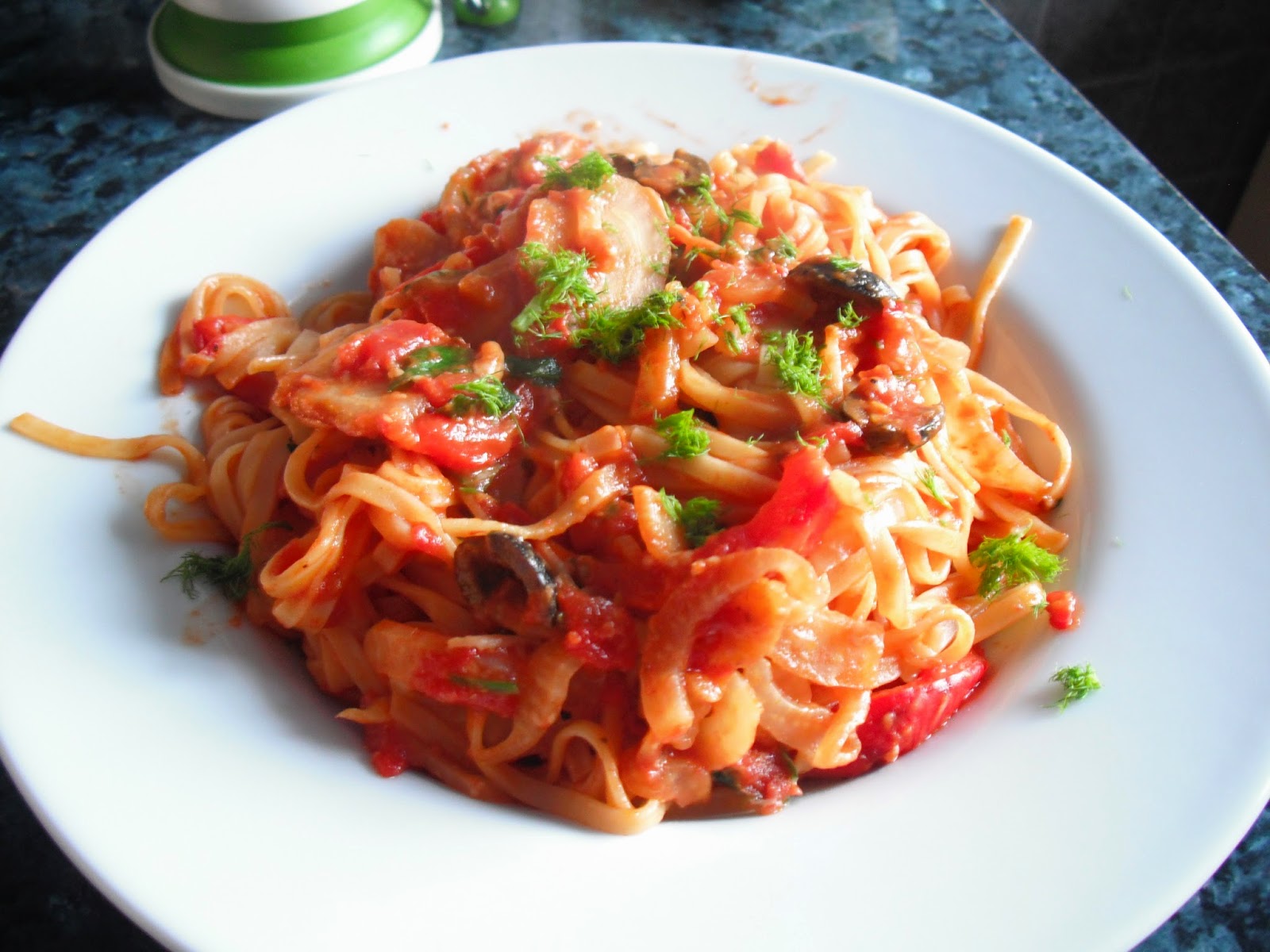
Experiments with HelloFresh #3: Fennel & Olive Fettuccine with Fresh Parsley
No, I haven't forgotten how to count, this should really have been the final post, but I'm temporarily skipping the second for reasons I'll get into when I finally post it. I'll also do the summing-up with that post rather than this one, as it'll make more sense that way.
As much as anything on this blog makes sense, that is.
After doing things in my usual haphazard fashion on the first recipe, my girlfriend mentioned that, when she's cooking, she'll often do snippets of preparatory chopping throughout the day, by way of a five minute break from her studies. While I wasn't quite that organised, I did make a start on this earlier in the evening than with any of my previous efforts, and did most of the chopping in advance of any of the actual cooking. I also followed another bit of her advice: she'd seen and heard my frustration with all the 'finely chop ingredient x' malarky in the first post and, when it came to the garlic, she suggested I simply use our garlic press. The end result is basically the same, if not better, and saves on an awful lot of effort. It was also nice to have a genuine reason to use my mortar and pestle for a change, grinding the fennel seeds - I knew I'd bought it for a reason...
I was particularly tickled, too, when the instructions helpfully suggested a mandolin for thinly slicing the fennel. My girlfriend picked one up a while back and, while it's not quite fine enough to generate the 'almost translucently thin' slices the instructions specified, it certainly made short work of slicing the awkwardly-shaped fennel bulb.
Once the chopping was out of the way, I read through the instructions several times over. Unlike the first two recipes, there weren't any massive glitches in the ingredient quantities (although specifying '2 cups' of sliced fennel bulb seemed redundant considering only one bulb was provided, and I kinda had to use the whole thing one way or another), so I really just wanted to be sure of what I needed to do next at every step, and to get a vague idea of the timings before starting things off. The second step in the recipe is cooking the red pepper strips, for which it recommends "15 mins or until lightly charred on the outside". The next step is cooking the rest of the veg in a pan, eventually turning it into a sauce for the pasta. The timings seemed to match up pretty well, so I started each process almost simultaneously, just to see if I could keep things on track.
The sauce comes together in several short stages that I found reasonably easy to follow since I had everything ready-prepared around me. The only hitch I'd had was that this recipe calls for black olives, and I definitely didn't get any black olives in the box. Thankfully, my girlfriend really likes olives, so we tend to have some in stock. The only real difficulty then was that, again, it specified the olive content as '2 tablespoons', which I still say is an utterly ridiculous measure for bisected fruit. Still, the definition gleaned from the first recipe helped me choose the appropriate number of olives for this dish. When the tinned tomatoes are added to the pan, the recipe suggests adding sugar but I've never found that necessary - tomatoes are sweet enough and, coupled with the rest of the veg, there's enough sugar in there naturally for my tastebuds. And that's saying something.
Once everything is in the pan, the recipe instructs that the heat should be turned down low so the sauce can boil down and thicken up, and it's at this point that the pasta needs to be cooked. Personally, I found it amusing that the card includes a definition of 'al dente' under the heading 'Tip', but your mileage may vary.
Just to prove that I'm not consistently terrible at cooking, the pasta was done only moments before the oven's alarm went off to tell me that the red pepper strips were ready, so both elements were added to the sauce in the pan in good time. The final stage was chucking in the parsley and the cheese (which strikes me as odd, and one of the Gousto recipes did the same, where my girlfriend and I would normally tend to add the cheese on top, once the meal had been served... not least because it means you don't end up having to scrape congealed cheese off your pan when you do the washing up). With a final garnish of - oh, for fuck's sake - 'finely chopped' fennel fronds, dinner was served...
Based on the two recipes I bothered photographing myself, I have to conclude that there's something wrong with HelloFresh's photography or their Photoshop work, as both this and the 'Easter' Ragu were depicted as rather brown in the stock photos, while they tended more toward red when I'd finished cooking... and I'm pretty sure I didn't get anything that significantly wrong on either of these.
As we were eating, my girlfriend commented that the fennel was identifiable in the sauce, but not overpowering, as fennel can sometimes be - being almost licorice in flavour. I certainly enjoyed the dish, but have to say I found it rather bland overall... it's possible I gave it too few "good grinds of black pepper", or that the chilli was just cooked for too long - it didn't have the spicy kick I was expecting, given that the first instruction says to "finely chop as much of the chilli as you dare". Perhaps I'll have to try this one again, and deliberately try to spice it up as much as possible...
This was definitely the easiest of the three HelloFresh recipes for me to follow, though how much of that was down to me doing more preparatory work in advance, and how much was because the recipe is actually easier, I cannot say. What I will say is that the card reckons this should be done in about 25 minutes, and I took the best part of an hour over it. Admittedly, most of that was due to taking my time over the preparatory work and my neurotic re-reading of the instructions, but that's a hell of a discrepancy. Not to say I particularly rate myself as any kind of kitchen ninja, but the folks at HelloFresh do seem to presume a level of competence far higher than mine.
If you think you might fancy giving HelloFresh a try (and are within the UK mainland), please feel free to use my referral code MPMDQT for an introductory discount. Yes, that also gets me a discount on my next order, but further deliveries are currently on hold while I complete this first set of recipes and consider how this system fits in with my current... erm... 'lifestyle'.
As much as anything on this blog makes sense, that is.
After doing things in my usual haphazard fashion on the first recipe, my girlfriend mentioned that, when she's cooking, she'll often do snippets of preparatory chopping throughout the day, by way of a five minute break from her studies. While I wasn't quite that organised, I did make a start on this earlier in the evening than with any of my previous efforts, and did most of the chopping in advance of any of the actual cooking. I also followed another bit of her advice: she'd seen and heard my frustration with all the 'finely chop ingredient x' malarky in the first post and, when it came to the garlic, she suggested I simply use our garlic press. The end result is basically the same, if not better, and saves on an awful lot of effort. It was also nice to have a genuine reason to use my mortar and pestle for a change, grinding the fennel seeds - I knew I'd bought it for a reason...
I was particularly tickled, too, when the instructions helpfully suggested a mandolin for thinly slicing the fennel. My girlfriend picked one up a while back and, while it's not quite fine enough to generate the 'almost translucently thin' slices the instructions specified, it certainly made short work of slicing the awkwardly-shaped fennel bulb.
Once the chopping was out of the way, I read through the instructions several times over. Unlike the first two recipes, there weren't any massive glitches in the ingredient quantities (although specifying '2 cups' of sliced fennel bulb seemed redundant considering only one bulb was provided, and I kinda had to use the whole thing one way or another), so I really just wanted to be sure of what I needed to do next at every step, and to get a vague idea of the timings before starting things off. The second step in the recipe is cooking the red pepper strips, for which it recommends "15 mins or until lightly charred on the outside". The next step is cooking the rest of the veg in a pan, eventually turning it into a sauce for the pasta. The timings seemed to match up pretty well, so I started each process almost simultaneously, just to see if I could keep things on track.
The sauce comes together in several short stages that I found reasonably easy to follow since I had everything ready-prepared around me. The only hitch I'd had was that this recipe calls for black olives, and I definitely didn't get any black olives in the box. Thankfully, my girlfriend really likes olives, so we tend to have some in stock. The only real difficulty then was that, again, it specified the olive content as '2 tablespoons', which I still say is an utterly ridiculous measure for bisected fruit. Still, the definition gleaned from the first recipe helped me choose the appropriate number of olives for this dish. When the tinned tomatoes are added to the pan, the recipe suggests adding sugar but I've never found that necessary - tomatoes are sweet enough and, coupled with the rest of the veg, there's enough sugar in there naturally for my tastebuds. And that's saying something.
Once everything is in the pan, the recipe instructs that the heat should be turned down low so the sauce can boil down and thicken up, and it's at this point that the pasta needs to be cooked. Personally, I found it amusing that the card includes a definition of 'al dente' under the heading 'Tip', but your mileage may vary.
Just to prove that I'm not consistently terrible at cooking, the pasta was done only moments before the oven's alarm went off to tell me that the red pepper strips were ready, so both elements were added to the sauce in the pan in good time. The final stage was chucking in the parsley and the cheese (which strikes me as odd, and one of the Gousto recipes did the same, where my girlfriend and I would normally tend to add the cheese on top, once the meal had been served... not least because it means you don't end up having to scrape congealed cheese off your pan when you do the washing up). With a final garnish of - oh, for fuck's sake - 'finely chopped' fennel fronds, dinner was served...
Based on the two recipes I bothered photographing myself, I have to conclude that there's something wrong with HelloFresh's photography or their Photoshop work, as both this and the 'Easter' Ragu were depicted as rather brown in the stock photos, while they tended more toward red when I'd finished cooking... and I'm pretty sure I didn't get anything that significantly wrong on either of these.
As we were eating, my girlfriend commented that the fennel was identifiable in the sauce, but not overpowering, as fennel can sometimes be - being almost licorice in flavour. I certainly enjoyed the dish, but have to say I found it rather bland overall... it's possible I gave it too few "good grinds of black pepper", or that the chilli was just cooked for too long - it didn't have the spicy kick I was expecting, given that the first instruction says to "finely chop as much of the chilli as you dare". Perhaps I'll have to try this one again, and deliberately try to spice it up as much as possible...
This was definitely the easiest of the three HelloFresh recipes for me to follow, though how much of that was down to me doing more preparatory work in advance, and how much was because the recipe is actually easier, I cannot say. What I will say is that the card reckons this should be done in about 25 minutes, and I took the best part of an hour over it. Admittedly, most of that was due to taking my time over the preparatory work and my neurotic re-reading of the instructions, but that's a hell of a discrepancy. Not to say I particularly rate myself as any kind of kitchen ninja, but the folks at HelloFresh do seem to presume a level of competence far higher than mine.
| Probably the neatest presentation I've ever managed when cooking for myself and my girlfriend... |
If you think you might fancy giving HelloFresh a try (and are within the UK mainland), please feel free to use my referral code MPMDQT for an introductory discount. Yes, that also gets me a discount on my next order, but further deliveries are currently on hold while I complete this first set of recipes and consider how this system fits in with my current... erm... 'lifestyle'.
Tuesday, 15 October 2013
More-ish Mushroom & Rice (BBC GoodFood 'One Pot' Recipe)
One of the things my girlfriend and I are trying to do as much as possible at the weekends is properly cooking our meals rather than relying on takeaways, restaurants and ready meals. The trick is that I'm a carnivore and she's vegetarian, so it has to be something that can have meat thrown in at the end, or something with enough flavour that I can live without meat. To make things easier, we both have a selection of recipe books - some veggie, some not - so there are plenty of existing recipes we can try before getting all experimental.
This recipe comes from BBC/GoodFood's '101 More One-Pot Dishes', which is why I'm linking to that rather than doing my usual list of ingredients, then all the details of how it was made. Instead, I'll just deal with a few brief bits, then end on a nice, large photo.
Making this from scratch was probably the first time I've had any significant exposure to the concept of using fresh herbs rather than dried and, while I could certainly taste the difference, the fact that fresh herbs start wilting within a couple of days of purchase means I'm unlikely to start buying them regularly. I did have a small herb basket hanging outside my kitchen window, but haven't replanted since the first crop died, unharvested, and it's now overgrown with weeds. It's also worth noting that I'm not a fan of tinned tomatoes of any kind, so it was pretty strange - I won't glorify my neuroses by using a word like 'daring' - for me to try this recipe.
The end result is very sticky rice which has absorbed plenty of flavour from the veg while leaving the peppers, onion and mushrooms with enough texture that you don't feel like you're eating a very thick rice-based soup. I'm not sure that the specified amount of rosemary is quite enough unless you get creative with other spices, but it certainly adds something to the few mouthfuls it turns up in, and the parsley garnish brings a welcome crispness. It's also surprisingly sweet - or possibly not surprising considering it contains fried onions, peppers and tomato - so that should be kept in mind if adding anything to the mix, particularly with meat.
It's a ridiculously simple recipe - the most complicated part is seeding and slicing the peppers - takes less than an hour (particularly when made by two pairs of hands), and creates about four portions worth, so any spare can be refrigerated for another time. It's also very adaptable - you can start with multi-coloured peppers, add other herbs and spices, some meat or, as we tried for lunch the next day, stir-fry it with some egg for a bit of extra protein.
This recipe comes from BBC/GoodFood's '101 More One-Pot Dishes', which is why I'm linking to that rather than doing my usual list of ingredients, then all the details of how it was made. Instead, I'll just deal with a few brief bits, then end on a nice, large photo.
Making this from scratch was probably the first time I've had any significant exposure to the concept of using fresh herbs rather than dried and, while I could certainly taste the difference, the fact that fresh herbs start wilting within a couple of days of purchase means I'm unlikely to start buying them regularly. I did have a small herb basket hanging outside my kitchen window, but haven't replanted since the first crop died, unharvested, and it's now overgrown with weeds. It's also worth noting that I'm not a fan of tinned tomatoes of any kind, so it was pretty strange - I won't glorify my neuroses by using a word like 'daring' - for me to try this recipe.
The end result is very sticky rice which has absorbed plenty of flavour from the veg while leaving the peppers, onion and mushrooms with enough texture that you don't feel like you're eating a very thick rice-based soup. I'm not sure that the specified amount of rosemary is quite enough unless you get creative with other spices, but it certainly adds something to the few mouthfuls it turns up in, and the parsley garnish brings a welcome crispness. It's also surprisingly sweet - or possibly not surprising considering it contains fried onions, peppers and tomato - so that should be kept in mind if adding anything to the mix, particularly with meat.
It's a ridiculously simple recipe - the most complicated part is seeding and slicing the peppers - takes less than an hour (particularly when made by two pairs of hands), and creates about four portions worth, so any spare can be refrigerated for another time. It's also very adaptable - you can start with multi-coloured peppers, add other herbs and spices, some meat or, as we tried for lunch the next day, stir-fry it with some egg for a bit of extra protein.
Friday, 11 November 2011
Iceland Ready To Cook Mediterranean Stuffed Peppers
Let this be a cautionary tale. There are some things that can only ever be made fresh, and certain types of vegetable should never, under any circumstances, be frozen.
Although, technically, they're fruit... because they contain seeds within a soft, juicy outer body.
But let's not get sidetracked by semantics... Leave that for another blog.
I have to say that, when I first set eyes on these, my first thought was "why bother? Something like that would be so easy to throw together from scratch." Basically, what this package contains is half a red pepper and half a yellow pepper, each containing slices or chunks of tomato, potato, onion, green pepper, garlic, carrot and pineapple, along with 'Mediterranean seasoning' and rice (of the white and 'glutinous' varieties). There some kind of 'sauce' thing going on, because the end result is fairly moist and sticky - moreso than one would expect from just mixing all of those veg together with a simple seasoning. Maybe I'm wrong... perhaps I'll have to try it...
In theory, I knew what to expect - the stuffed peppers should have been fairly sweet, on balance, but with a sharp, savoury edge to keep things interesting.
What I actually got, after 25 minutes in the oven, was one of the worst snacking experiences I've thusfar had. Imagine, if you will, a flavour that is equal parts vegetable melange and washing up liquid. Bitter doesn't begin to describe it.
I'm going to blame this entirely on freezing... Freezing, except when done incredibly quickly, increases the amount of water in a product and, when you're talking about peppers, than can only be a bad thing. Freezing will also damage 'meat' of a pepper, making the end result softer and more fragile than it would have been made fresh. Green pepper in particular is a difficult flavour to freeze. The bitterest of the family already, that bitterness is generally the only thing to survive the freezing process, and is often amplified along the way.
Then there's the rice... Very rarely does that come out well from frozen. Personally, I almost never use anything but those handy microwave sachets of rice, because they're so convenient. I've tried rice from frozen, and it ends up either too dry or too glutinous. The rice in this product falls into the latter category.
My only other complaint would be the size of the portions: what the packaging describes as 'pepper halves' seemed far more like thirds. They were shallow and saggy, far moreso than one would expect from a true half, though I realise some of this could be another side-effect of the freezing process.
Overall, I can't recommend trying these... but they did make me want to try making something similar from scratch.
Now if only I could figure out what makes a 'Mediterranean seasoning'...
Although, technically, they're fruit... because they contain seeds within a soft, juicy outer body.
But let's not get sidetracked by semantics... Leave that for another blog.
I have to say that, when I first set eyes on these, my first thought was "why bother? Something like that would be so easy to throw together from scratch." Basically, what this package contains is half a red pepper and half a yellow pepper, each containing slices or chunks of tomato, potato, onion, green pepper, garlic, carrot and pineapple, along with 'Mediterranean seasoning' and rice (of the white and 'glutinous' varieties). There some kind of 'sauce' thing going on, because the end result is fairly moist and sticky - moreso than one would expect from just mixing all of those veg together with a simple seasoning. Maybe I'm wrong... perhaps I'll have to try it...
In theory, I knew what to expect - the stuffed peppers should have been fairly sweet, on balance, but with a sharp, savoury edge to keep things interesting.
What I actually got, after 25 minutes in the oven, was one of the worst snacking experiences I've thusfar had. Imagine, if you will, a flavour that is equal parts vegetable melange and washing up liquid. Bitter doesn't begin to describe it.
I'm going to blame this entirely on freezing... Freezing, except when done incredibly quickly, increases the amount of water in a product and, when you're talking about peppers, than can only be a bad thing. Freezing will also damage 'meat' of a pepper, making the end result softer and more fragile than it would have been made fresh. Green pepper in particular is a difficult flavour to freeze. The bitterest of the family already, that bitterness is generally the only thing to survive the freezing process, and is often amplified along the way.
Then there's the rice... Very rarely does that come out well from frozen. Personally, I almost never use anything but those handy microwave sachets of rice, because they're so convenient. I've tried rice from frozen, and it ends up either too dry or too glutinous. The rice in this product falls into the latter category.
My only other complaint would be the size of the portions: what the packaging describes as 'pepper halves' seemed far more like thirds. They were shallow and saggy, far moreso than one would expect from a true half, though I realise some of this could be another side-effect of the freezing process.
Overall, I can't recommend trying these... but they did make me want to try making something similar from scratch.
Now if only I could figure out what makes a 'Mediterranean seasoning'...
Subscribe to:
Posts (Atom)